
By Paul Greenberg
Photography by Jake Wheeler
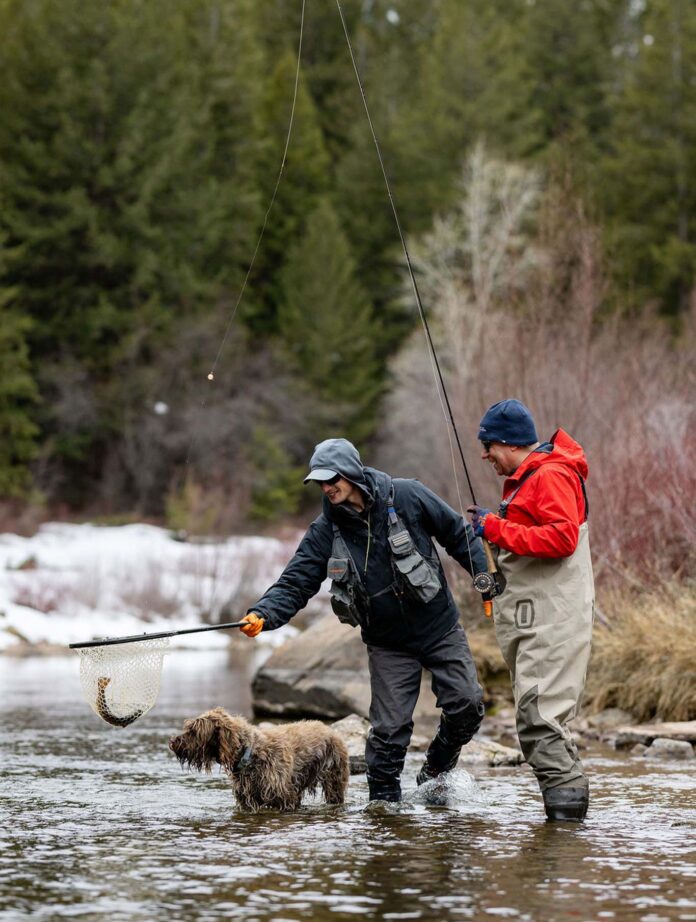
The two-foot-long fish on the end of my line seemed to be showing off. My guide, Sam Merrill, could see when it turned sideways against the flow of the Fryingpan River that it had the bright chrome and fiery red stripe of a rainbow trout. Evidently, it also had an expert’s knowledge of the country through which it was swimming: After taking my fly in the deep water of a pool, it shot out into stronger current and made for a chute that would take it downstream into whitewater. There it would undoubtedly find the right rock to saw off my leader, the sturdy stretch of line connecting the main line to the hook.
Anticipating this clever maneuver, Merrill had already splashed down to the head of the rapid in an attempt to net the trout as it skittered toward the churn. That didn’t strike me as particularly sporting, so I laid my rod sideways, as I’d seen the pros in fly-fishing magazines do, and hoped that the deep bend in my pole and the drag on my reel might persuade the fish to stay upstream. The fact that it was winter—and the water was 38 degrees Fahrenheit—only further incentivized my desire to stay put. I didn’t want to chase a fish into the rapids and risk hypothermia if I fell and flooded my waders.

Now, you could ask here why a person who’d come to Aspen and set up at The Little Nell in the midst of winter wasn’t at this very moment making his way up Aspen Mountain on skis. Why had I doglegged to the nearby Roaring Fork Valley to risk a plunge in icy water instead of schussing all day in perfect powder?
Well, in spite of writing my fair share of ski articles and teaching my son how to snowplow and eventually connect turns—I do not like to ski. I like to fish. And March, the absolute peak of the Western ski season, it turns out, is also the absolute best time to fly-fish for gorgeous trout in one of the most beautiful settings an angler could imagine.
I was tipped off to the great quality of trout fishing in Colorado ski country by the amiable Scott Spooner, longtime owner-operator of Taylor Creek Fly Shop in Basalt, about 30 minutes due north from downtown Aspen. A few weeks prior to my trip, he laid out numbers I couldn’t quite believe. “In order for a river to qualify as having Gold Medal status, it has to have 60 pounds of trout per acre,” Spooner told me. “We’ve measured over 600 pounds per acre.”


I couldn’t quite believe my ears, but turns out, it’s true. Because of light fishing pressure—which drops to almost nothing in wintertime—plus a steep gradient and an abundance of cold, oxygenated water that is evenly released from the dam above the prime waters of the Fryingpan, the naturally self-reproducing population of mostly brown trout does very well here. Add to that a feed supply of mysis shrimp that comes down from the reservoir and terrific hatches of mayflies, caddis flies, and other creatures big trout love to eat, and, indeed, you get Gold Medal status many times over. With that many trout available, the only real question I had when I approached the shoreline of White River National Forest was how I was going to catch them.
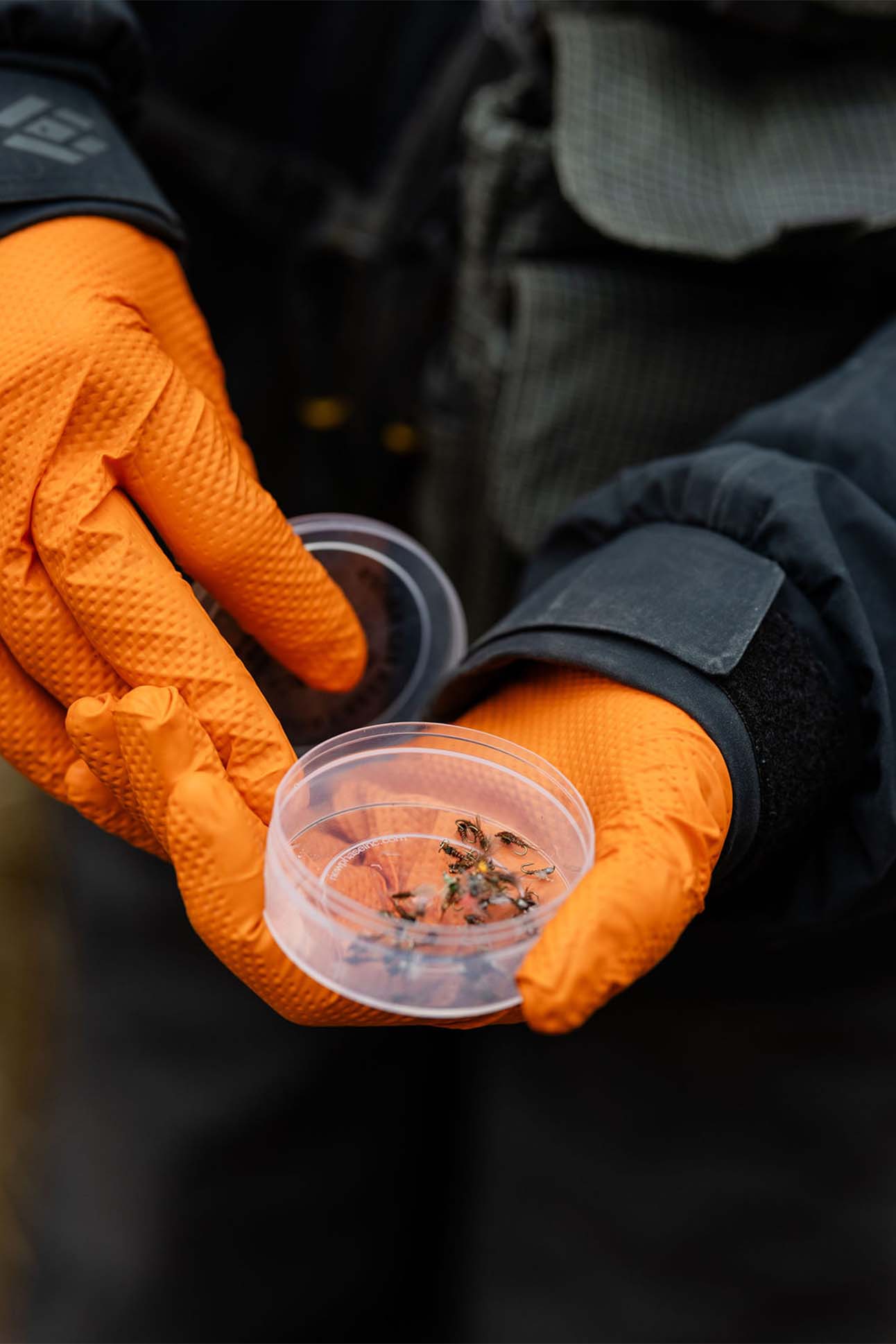
Fishing luck being fishing luck, I did not arrive at the banks of the Fryingpan River on a bluebird day. A slight chill was in the air, snow was on the ground, and the clouds, though they played with the idea of parting, decided to stay slate-gray shut. Merrill informed me we would have to “nymph”—that is, use flies that imitate the aquatic insects that trout feed on below the surface of the river.
He tied on a pair of tiny size 22 nymphs with a float positioned above and instructed me to make short casts over a series of submerged boulders just a few feet from my waders. “Hit ’em,” he said every time the float paused for a millisecond in the current. Those little pauses were brown trout taking my nymph and promptly spitting it out. I couldn’t believe I was getting so many bites, but as I acclimatized to my polarized sunglasses, I began to see brown trout: one, two, then dozens and more. They were everywhere. In the clear water, Merrill showed me that if I looked closely, I could even see the whites of their mouths as they opened to take my fly.


I was hooked after the first nice brown trout came to the net. I was hooked even more when my 13th and final trout of the morning came ashore. I’d like to think I caught so many because I’m such a skilled angler, but, in truth, it was a situational triumph. Even beginners can easily bring in a maximum haul on the Fryingpan.
As the afternoon wound down, I did have one regret: I had not yet hooked a rainbow trout, the fish that represents only 5 percent of the current trout population of the river. I started to daydream about how they make long hard runs and, when all else fails, leap into the air to try to shake a fly loose from their jaws.
Suddenly, a powerful tug on my line interrupted my reverie. I peered into the water and saw the ruby-red flash from my dream—a rainbow trout three times as big as anything I’d hooked that day had taken my fly and was shooting downstream toward a rapid. I tried hard to keep it out of the whitewater. It zigged, it zagged, and it seemed like I just might land this fish, but on its third turn, the clever trout bounded off in a wide arc that gave it enough leverage. Ping! The hook pulled out. It was gone.

Usually ending a trip with the loss of such a big, beautiful fish would be a downer, but I realized that I had only scratched the surface of the tremendous number of winter fishing opportunities I could access a stone’s throw from Aspen. Maybe next winter I’d come back and float the mainstem of the Colorado River. Perhaps I’d work some of the other parts of the Fryingpan or hike up into some of the high-elevation ponds that host native, indigenous cutthroat trout.
While the rest of the winter wonderlanders skied till they dropped, I would have nearly an entire stream all to myself, doing what I loved most. There was so much water to explore.
To arrange fishing trips on the Fryingpan River and throughout the Roaring Fork Valley year-round, contact The Little Nell’s concierge team.