
By Sue Hostetler
Photography by Jason Schmidt
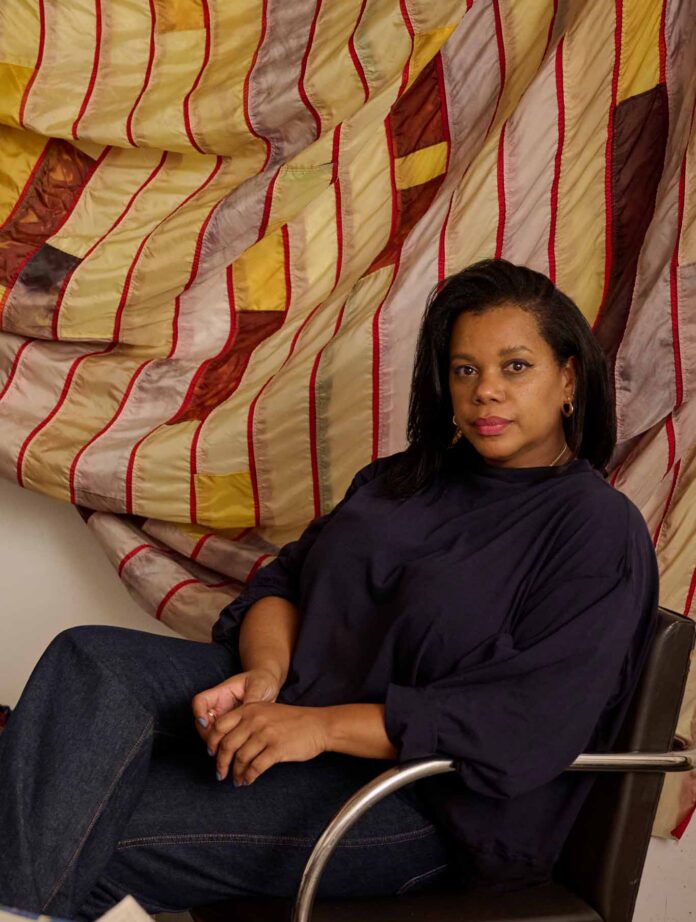
Working across the mediums of drawing, sculpture, and performance, Brooklyn-based visual artist Carla Edwards has gained acclaim for transforming familiar state symbols and American folk imagery into a powerful commentary on national identity. Her ongoing Flag Series—in which she deconstructs, dismantles, and re-dyes standard-issue American flags, then reassembles them into abstract quilt-like works—has captured the art world’s attention. On the heels of a string of high-profile exhibitions at major institutions—including Studio Museum in Harlem and Crystal Bridges Museum of American Art in Bentonville, Arkansas—Edwards sat down with art advisor and author Sue Hostetler, who assists in Aspen One’s curation, to discuss everything from the intrigue of zealous objects to the beauty of utilitarian tools.
Did you know as a child that you wanted to be an artist?
I didn’t really know that being a professional artist was something you could do. Where I grew up in northern Virginia most people worked for the government in some capacity, so I wasn’t exposed to a lot of artists. When I was a kid, I used to create these little projects and get lost for hours. I had an ongoing portrait drawing on the back of a wooden chessboard. I would work on it in secret and then tuck it away. I’m not sure why it had to be a secret, I think I wasn’t sure if it was “good,” and wanted to keep my little creative bubble intact. I knew that I was creative and took my art seriously. Beyond that I really didn’t have a clue.
You attended The Art Institute of Chicago and the Rhode Island School of Design (RISD). Can you describe what your art education looked like?
At that time, going to art school wasn’t as big a thing as it is now. I remember my father, who has always been really supportive, took me to a portfolio day that the School of the Art Institute of Chicago was doing at the Corcoran Gallery of Art in Washington, D.C., and we were just sort of winging it. He said, “The Art Institute has a really long line so it must be a good school.” Thankfully the reviewer liked my work, and I was accepted on the spot, so to speak, based on that one meeting. I was really lucky. Getting into that line was the best decision I ever made.
Being in Chicago in the late ’90s was like being cracked open. I learned so much, both in school and out, about art, survival, community, and music. It wasn’t easy, but it felt magical. By the time I got to RISD I still felt being an artist was out of reach, but I thought maybe I could work in academia. Having that RISD degree has definitely helped in that regard. But that debt is wild.
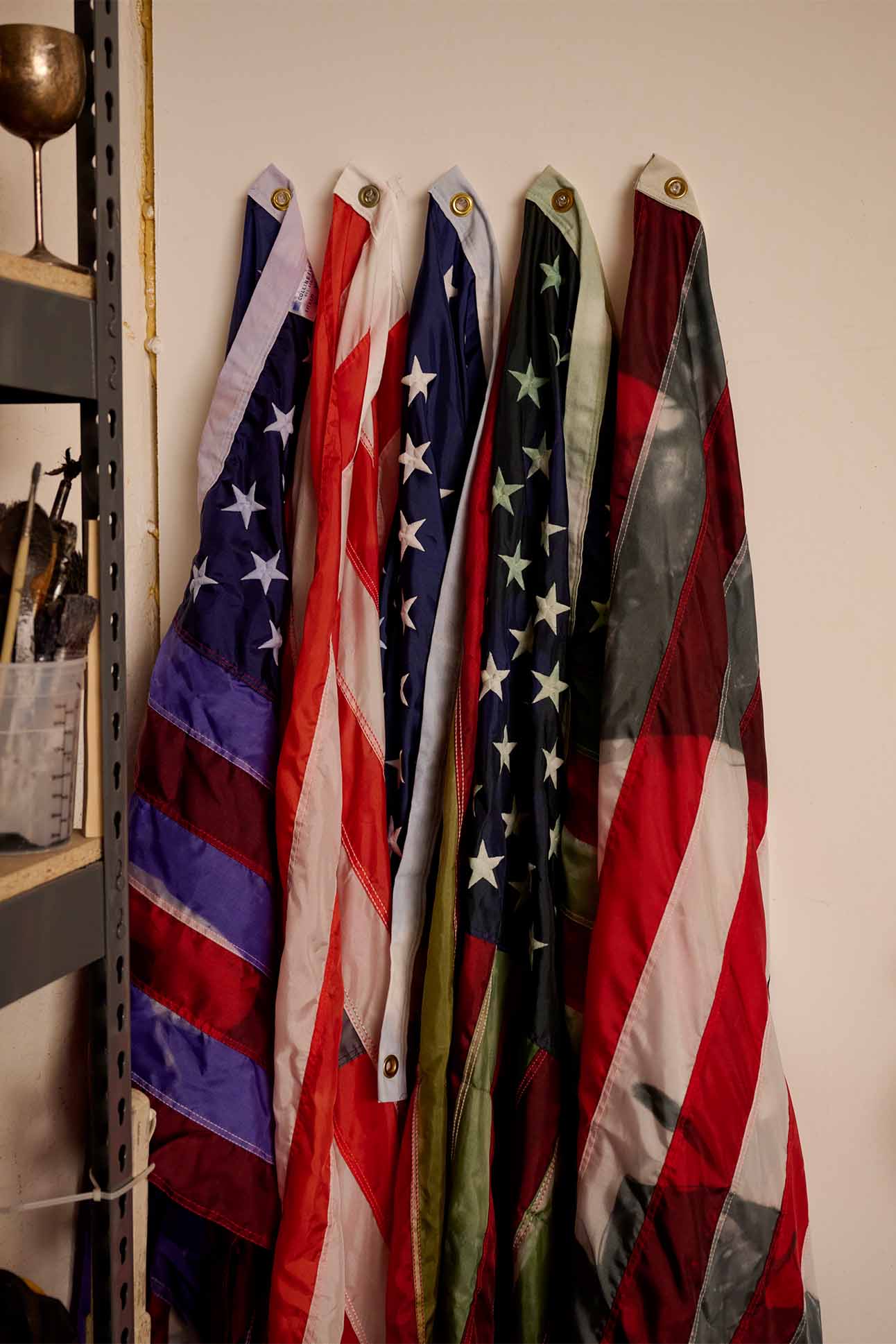
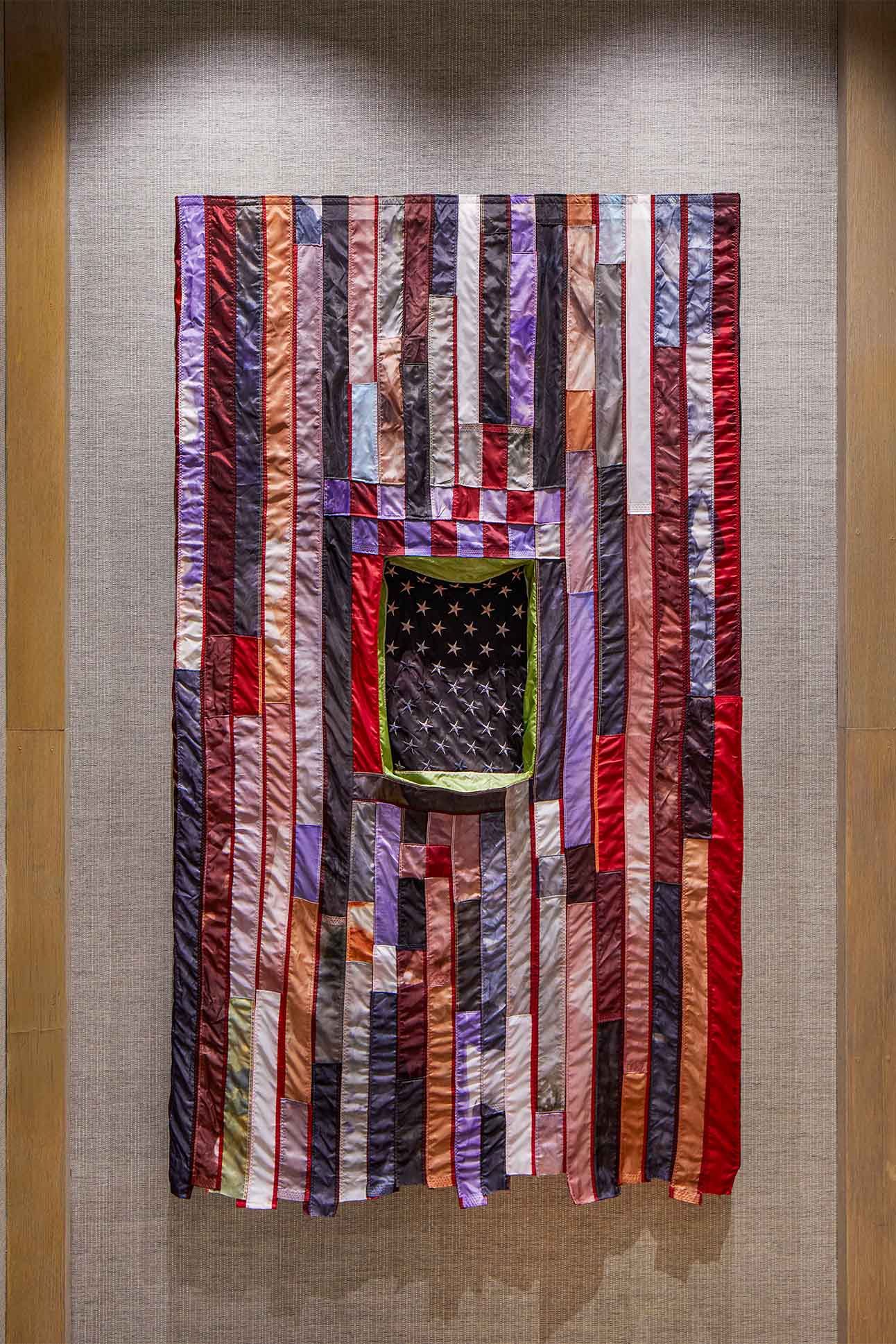
Your work manipulates and reconfigures cultural symbolic objects, like the American Circus deconstructed flag piece, which we purchased for The Little Nell. Are you attempting to alter the meaning of these iconic symbols for the viewer?
I hope that the works help viewers see representations like the flag as something that can be responsive and reflective. There is something subversive in all of the flags in the series—there’s agency. You have talked about being drawn to gestures or objects that carry intense devotion or zealous patriotism, or are passionately coveted. What makes these items so seductive to you?
I’m interested in objects and actions that seem to have the power to draw people in and hold their attention—that create some sort of collective buy-in. I have always been fascinated by how that happens, how people get together and decide that something will be meaningful. Or how some objects and actions turn into rituals repeated over and over for hundreds of years, and others just for a day.
Does working with a patriotic artifact like the American flag and disregarding the traditional state-issued protocols that these objects have—particularly during such a politically divisive environment—ever give you pause?
No, not at all. Creative expression is more important now than ever. When I started this series back in 2008, coming out of the Whitney Museum of American Art Independent Study Program, I felt a pause because I was tackling a subject that felt big, and it felt uncomfortable to align myself with such a symbol. The relationship did not feel easy or clear cut. But I took that as a sign that I was heading in the right direction. In 2008, economically in the U.S., things were hard for a lot of people, including myself, and here I was, reading theory at the Whitney program with people from all over the world. Many were coming from countries where their art and basic needs were being fully funded, and I felt my experience in sharp contrast to that.
But in many ways, it was incredibly privileged then and still is now to be in those kinds of spaces—like graduate school—and to have creative agency. So I was going to use it. The stakes and challenges now have only grown. But you asked about disregarding the protocols for [flag] handling. I do take intentional steps to challenge those protocols in my process and handling the material. For example, American Circus and a few others in the series are meant to touch the floor. The process for making these works is itself a challenge by design—cutting, dyeing, bleaching—my own little ritual. But there is also a lot of care and labor that goes into constructing these works.
Is the work a direct commentary on U.S. citizenship?
Not explicitly, but I am definitely responding to a broad range of conditions in the U.S. and processing what is happening around me intuitively through color and composition. So, I suppose citizenship is one aspect in the mix. But sometimes the lens is much narrower and more personal.
In another series you investigate the role that religious icons and objects have, and how these organized spiritual beliefs can be a mixed blessing, having both benefits and liabilities in our society. Can you describe the catalyst for these works?
I have always been interested in “yardwork,” a vernacular practice of creating elaborate displays in the front of your yard. You see these a lot in the deep South and Midwest, but they pop up all over, and I’ve always thought they were a really fascinating way of making a declaration—that certainty of just putting it all out there in front.
Are you referring to works like Gain and Cost, which was installed at Socrates Sculpture Park in Queens, and based on the bathtub Madonna—a lawn shrine or artificial grotto?
Yes, with that project I was really interested in what people were valuing at the time, so I decided to create a space for the public to engage in a not yet directed, public shrine. In the signage for the piece, viewers were invited to “leave objects devotional or otherwise” inside the sculpture. So the work grew and changed over the nine-month run of the show.
Walking around neighborhoods in Brooklyn, I noticed that all the artificial grottos people had in their yards to place saints and other iconography were the same. They might be painted differently or have different objects in them, but the grotto forms themselves seemed identical. So I tracked down a generational family business that made these grotto forms, and it turned out that they had been using the same single mold their grandfather had made for decades. I really loved that this single mold would be the vehicle for all of these people’s devotional expressions. I worked with them to create the five smaller grottos in that piece, modifying the casts by laying in pigmented concrete. I love that the grottos in Gain and Cost come from the same mother mold and formally connect to all the other grottos around the city.
Tell us about a new series of work or upcoming exhibition that you are particularly excited about.
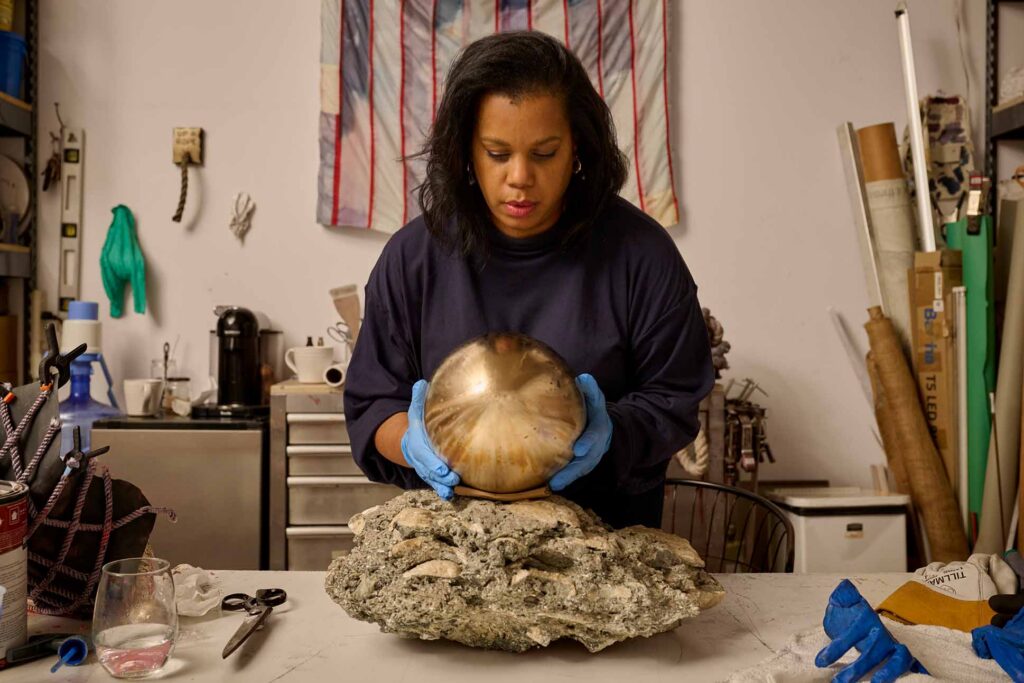
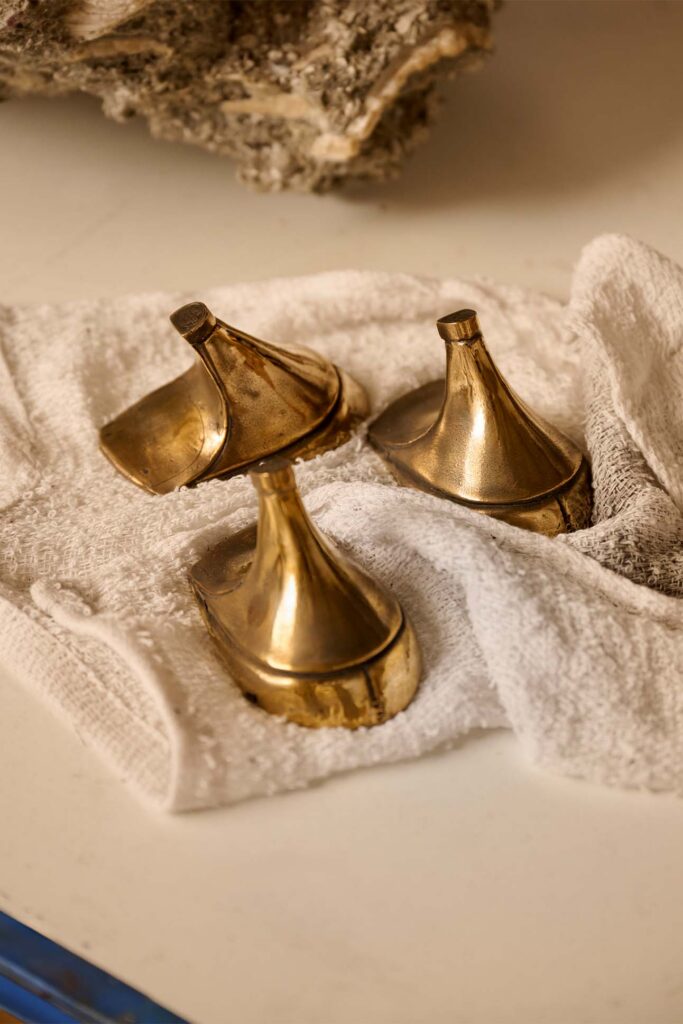
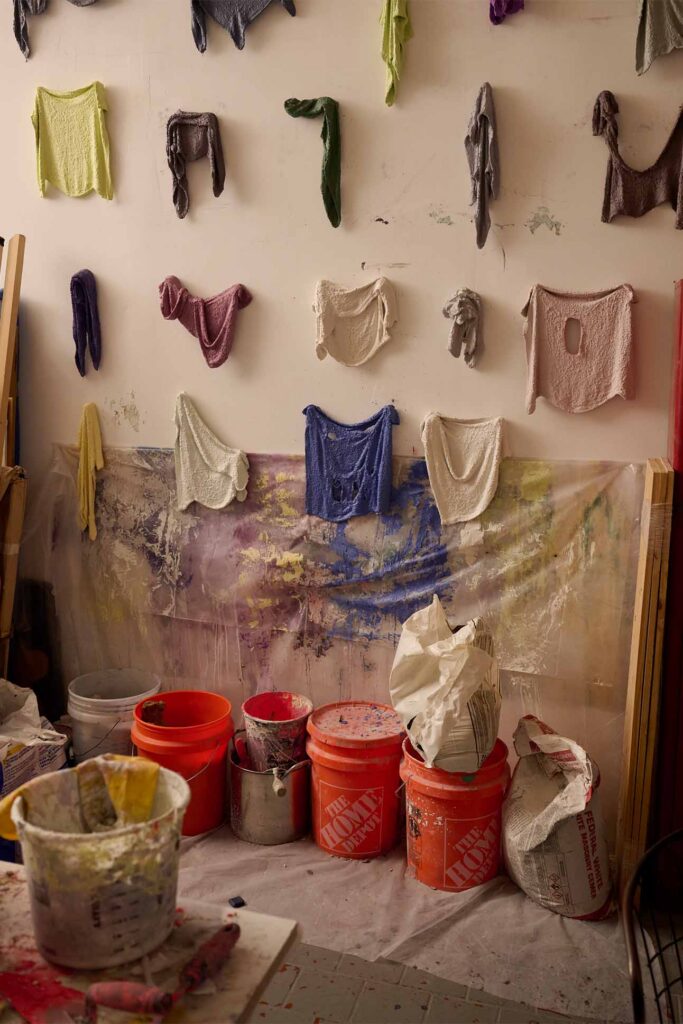
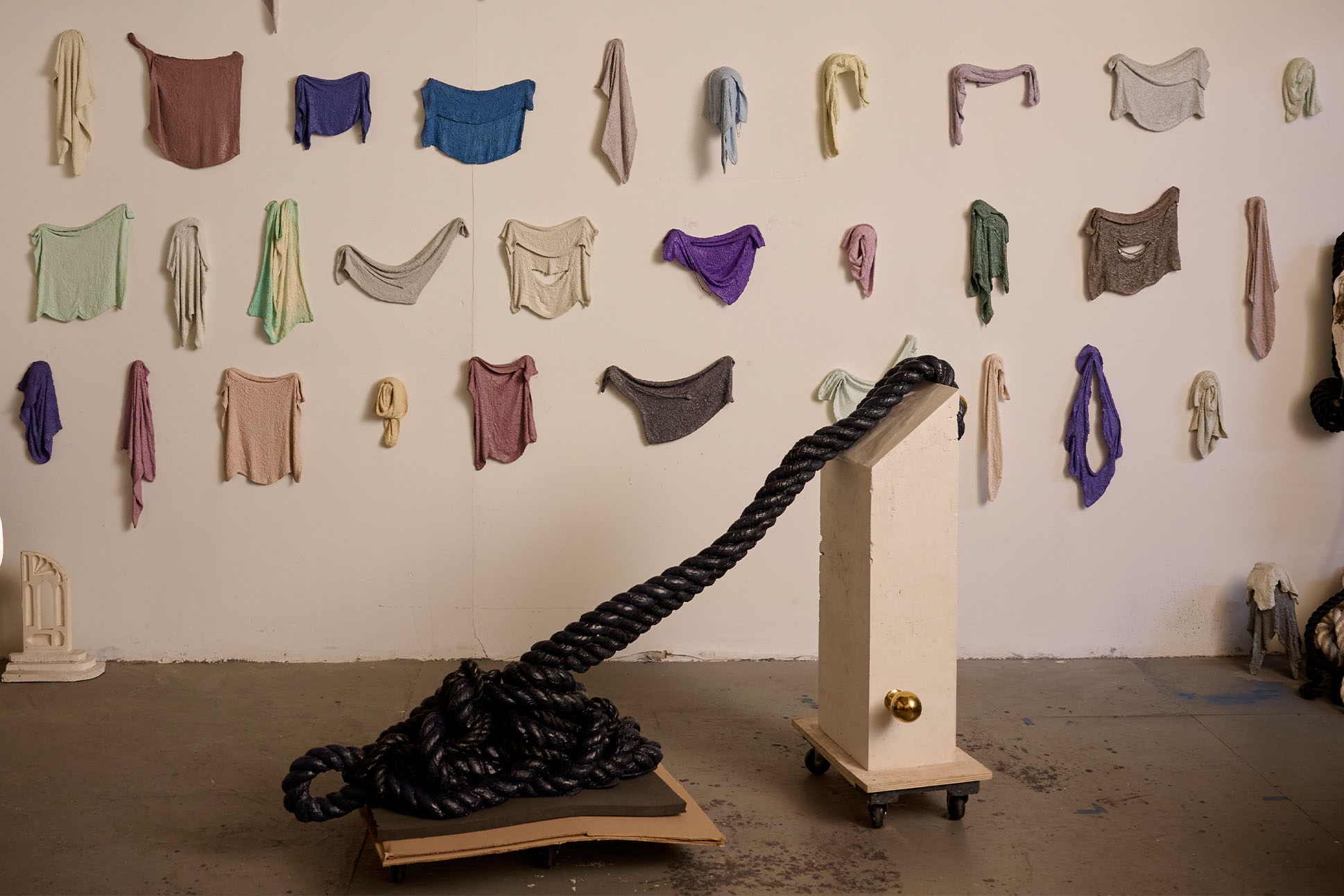
I am excited about the work that I am doing in the studio ahead of my solo show at Night Gallery in Los Angeles this November. For the last few years, I have been thinking a lot about labor and work, both in the studio as it relates to artmaking and more broadly culturally—specifically how it is valued or devalued. This has led me to working with a set of materials and processes that privilege the hand: tools, objects, and materials that aid in everyday work. Gloves, work rags, rope—I have been finding beauty in these objects and forms and turning things on their head a bit by elevating them and creating pairings with more traditional materials and processes like bronze casting.
It has been fun to get back to my roots in sculpture and metalworking, although there will also be some new flag works in the show as well. I’ve been thinking about aspects of Western art history, especially how the ability to depict or articulate draping fabric or garments has often been seen as a sign of artistic mastery. It can also become a way for an artist to play with sensuality or to really revel in and fall in love with the material they’re working with, whether that’s marble, paint, bronze, or something else. The show will be about the intersection of these two themes.